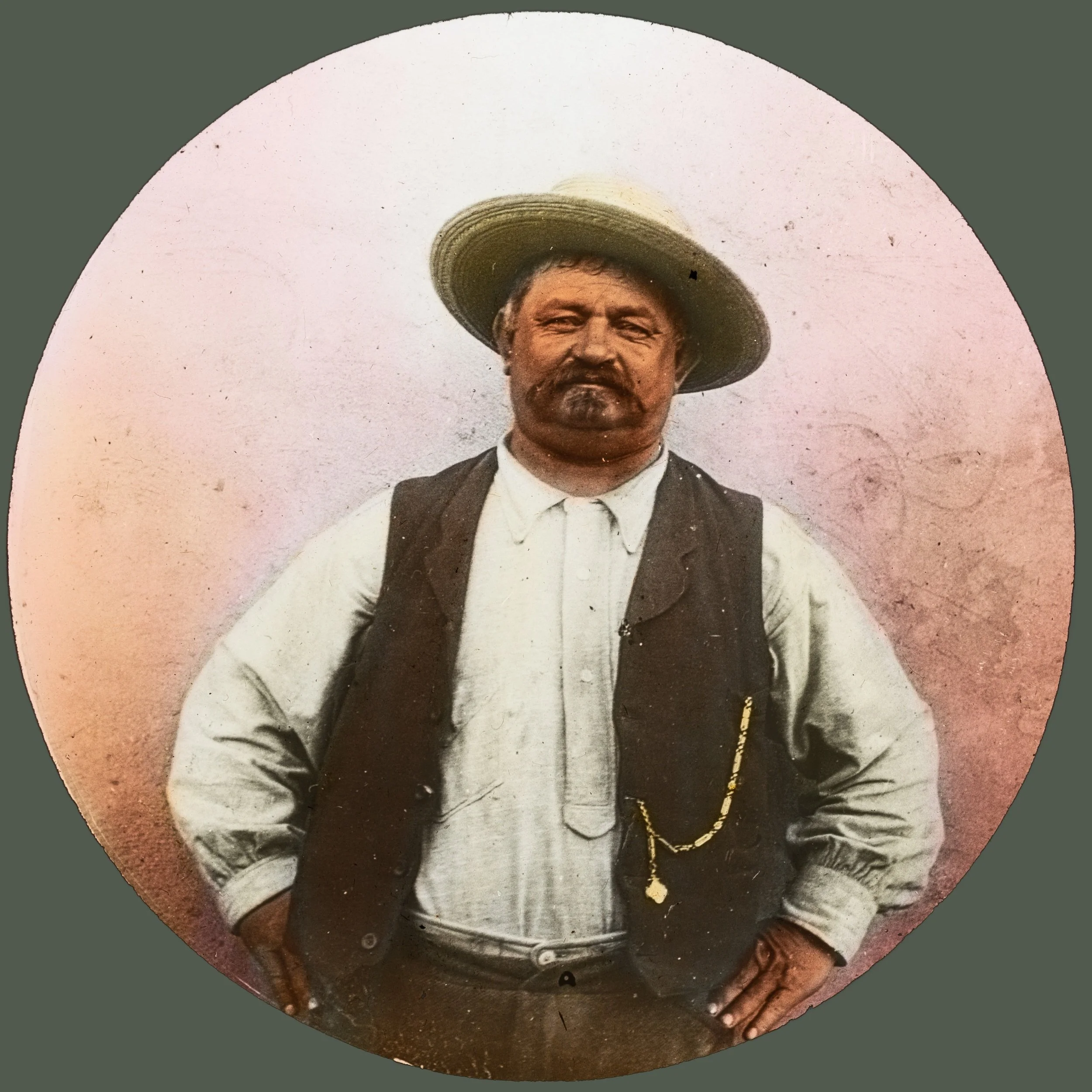
I’ll never know exactly who this gentleman was, or how his story fits into the grand narrative of California wine.
All that can be known for certain comes from the photograph’s title, “Sonoma County: Asti, Portrait of Man,” and the fact that it’s attributed to Frona Eunice Wait, who authored “Wines and Vines of California,” published in 1889.
I’ll tell you more about Frona and her book in a second.
That’s because even now, you already know enough to infer that this man worked in the Italian Swiss Agricultural Colony, which was founded (along with the town of Asti itself) in 1881.
And as it happens, that’s all the information I needed in order to know that the man from Asti’s image was perfectly emblematic of the west coast tradition
There’s a very good chance that he came to California from Italy, just like a few of my own forebears did.
All that I can know with certainty comes from the photo’s title, “Sonoma County: Asti, Portrait of a Man” and the credited photographer, Frona Eunice Wait, author of “Wines and Vines of California,” which has been called the most profoundly important record of the 19th Century California wine trade.
The image, (public domain, via the U.C. Davis library) is included in a record of the history of the Italian Swiss Agricultural Colony, which was founded in Asti in 1881.
Frona’s book, published in 1889, also chronicles the early history of the Colony,
The Colony was founded during the late 1800s, and quickly became NorCal’s center for production of affordable table wines. This made it a prominent tourist destination as well, an early wine trail of sorts, unitl well into the 20th century.
Much has been written about the Spanish Franciscans and their fraught connection to the origins of the California wine industry.
Although the monks may have been responsible for the first cultivations of ‘old world’ vines in Alta California, immigrants from Italy, Spain, Portugal, China and elsewhere pioneered commercial viticulture & the North American winemaking trade.
I don’t know who the man from Asti is. The pocket watch suggests some level of financial success - but his clothes are similar to what laborers wore at the time. Many have come to California to pursue their passion for wine. I’m one of them; and I chose this image as my avatar as an homage to his history.